
The Founder's Problem
KeyPing
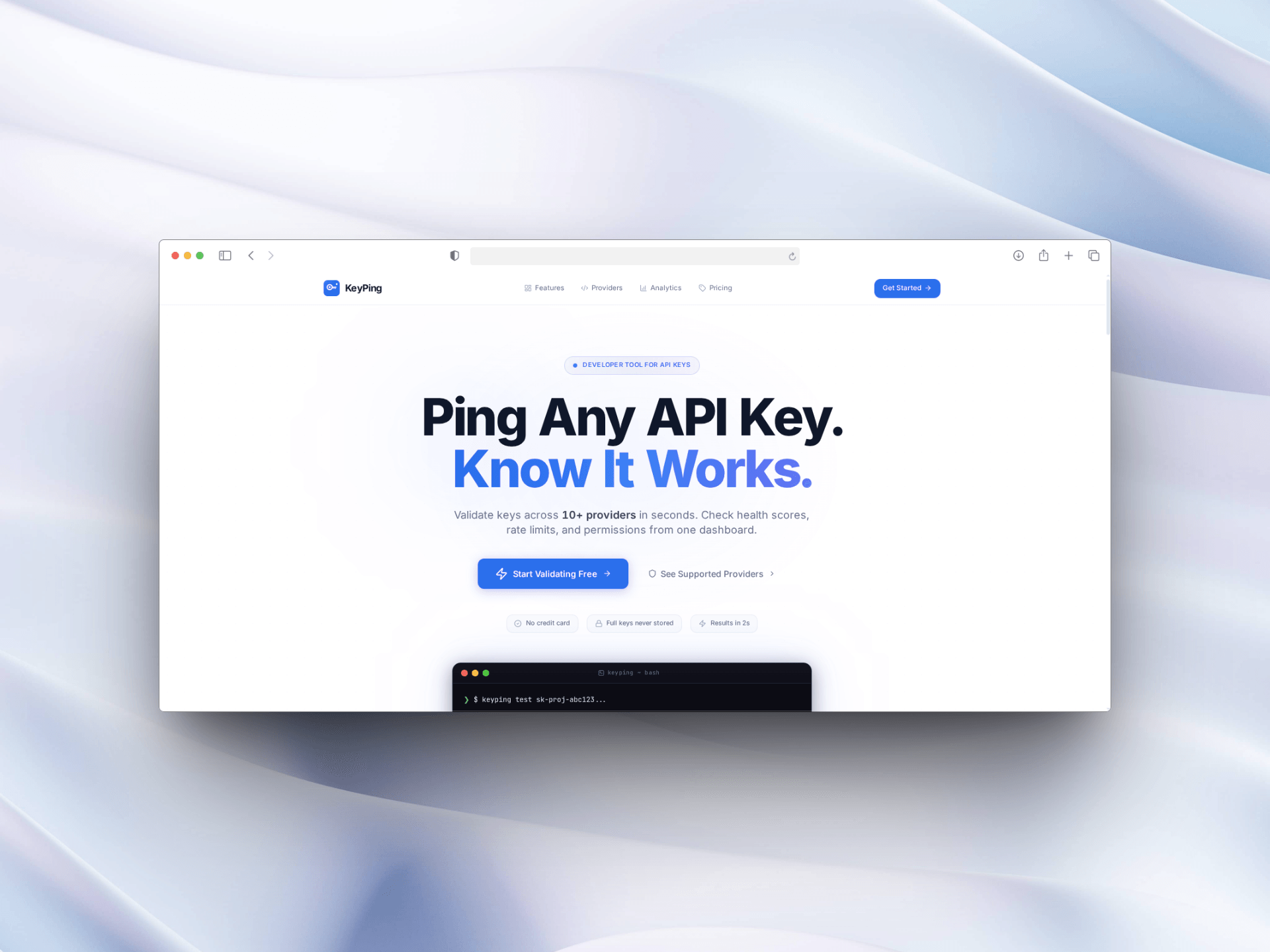
‘Invalid API key’ is the most frustrating error message in development. You waste 35+ minutes debugging across 10+ providers. Each has different validation endpoints, different error formats, and different rate limits. There’s no unified dashboard to check key health, until now.
Timeline
15 days
Solo sprint · full ownership
Target User
Developers & Engineering teams
Performance
Key validation in <2 seconds across 10+ providers
Why Alternatives Fell Short
- Every API provider validates keys differently. There’s no standard endpoint you can hit.
- Testing keys manually means writing custom scripts for each provider. That time adds up.
- Most teams discover expired keys only when production breaks. By then, users are already complaining.
- Keys get shared via Slack and email with zero audit trail. You don’t know who has access to what.
What I Built
Multi-provider validation supporting OpenAI, Gemini, Groq, Anthropic, Stripe, GitHub, Twitter/X, Notion, Supabase, AWS, and custom endpoints
Health score (0-100) factoring validity, scope coverage, rate limit status, and latency
Bulk testing: validate 10+ keys simultaneously with parallel requests
Team workspaces with role-based access and shared validation results
Tech Stack & Why
React 18 + Vite
Fast dev server with SWC. Production builds in seconds.
Supabase
PostgreSQL for full test history, Edge Functions for secure key validation without exposing credentials.
TanStack Query
Request deduplication prevents redundant API validations. Auto-retry on failure.
Recharts
Lightweight health score visualization. No heavy framework dependencies.
shadcn/ui
Consistent, accessible component library. Dark mode in 2 lines of Tailwind.
The 3-Week Process
Provider integration architecture, validation logic for 10 providers
Health scoring algorithm, bulk testing + queue system, team workspaces
Test history + search, expiry alerts, UI polish + deploy
Lessons Learned
Each provider returns errors differently. OpenAI uses HTTP codes, Stripe uses structured JSON. You need provider-specific parsers.
Health scoring needs weighted factors. Validity is 10x more important than latency. Weight accordingly.
Bulk testing without rate limiting will get you banned. Implemented a queue system with per-provider concurrency limits.
Team features drove adoption. Solo devs eventually leave; teams pay. Built for the enterprise buyer from day one.
Auto-detection saved 70% of users from manual provider selection. Pattern matching was worth the engineering time.
Would Do Differently
I'd build rate limiting on day one, not patch it in later. Per-provider concurrency limits are core architecture, and skipping them nearly triggered an OpenAI ban.